By Elizabeth Hadden, the third daughter of Milton and Ella Esson and great-granddaughter of Hanson and Lavina Stevens. The author wrote this story for the 112th Stevens family reunion held Jul. 21, 2002, at Maple Hill Farm.
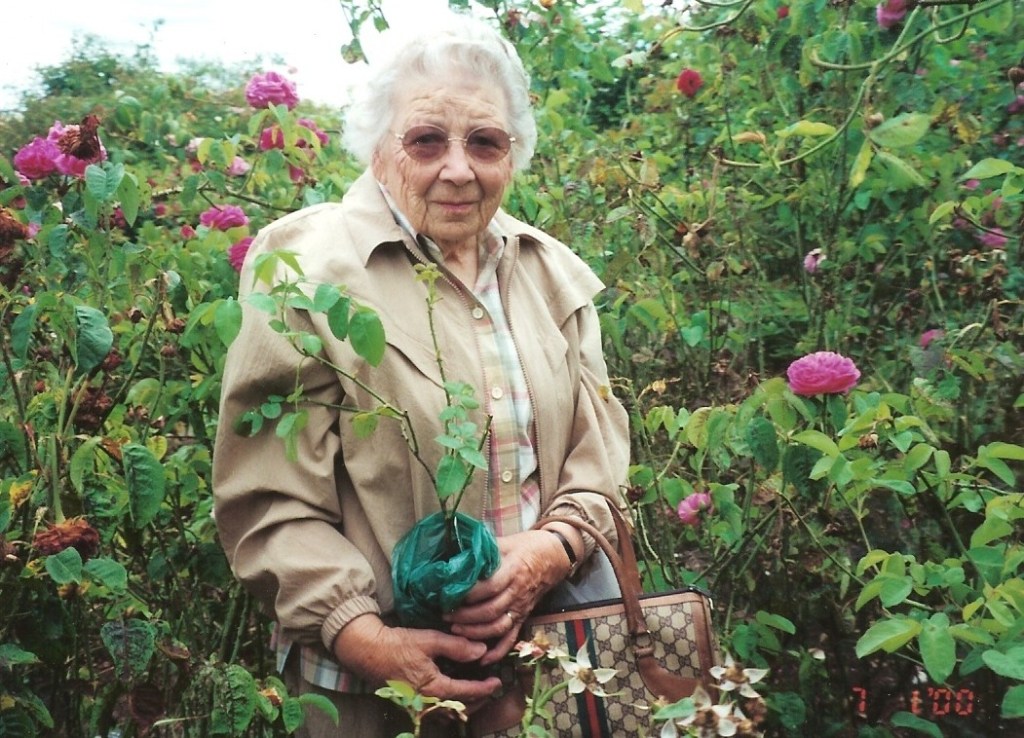
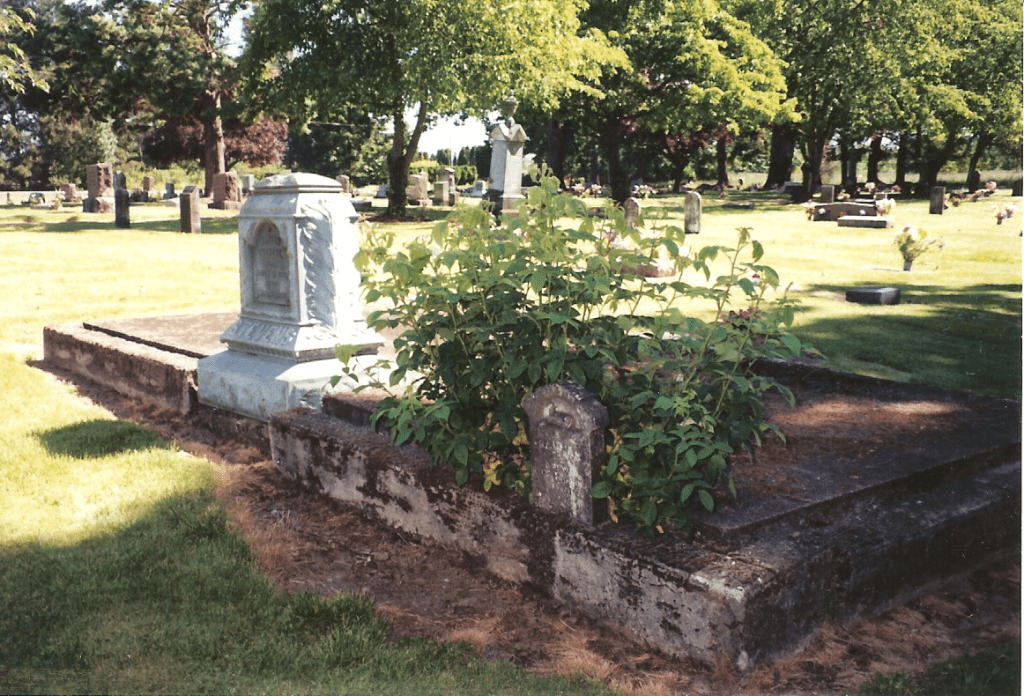
I have always been interested in growing flowers (probably a gene from the past). Cousin Dorothy Clevinger told us, at one of our reunions, that when she was a child she had seen a rosebush on the grave of Hanson and Lavina Stevens at Bethany Cemetery, and later saw an heirloom rose that looked like it. I became interested in trying to grow it myself and discover how it came to be.
For the past two years I have told you about my visit to Bethany Cemetery and taking two canes from the bush for propagating new plants. I had mediocre success the first year, and this year, mildew on the new plants was a problem.
I was successful, however, in raising a few bushes from the original rose canes, and in October 2001 I cut many 6-inch pieces from the canes of my thriving bushes at home. I placed them in damp sand to root. From these starts, I have grown the supply I have brought today. With the help of my “rose mentor,” Mr. Cochran, a friend in the community, we conquered the mildew and the roses are now ready for their new owners to take charge.
I have done some research to find out if our rosebush from the gravesite is the same as the one named “Baronne Provost.” The characteristics are similar. The “Baronne Prevost” rose began in France in 1841, cultivated by Mr. Desprez. In 2000, I purchased a bush with this name from the Heirloom Rose Garden in St. Paul, Oregon, and have grown it beside my progeny. They bloomed at the same time. They have the same wonderful aroma. The same rose-pink color. Quartered. The difference is that “Baronne Provost” has a more compact growth with many thorns, while our rose stems are quite smooth.
Mr. Cochran explained that in his experience growing roses from seedlings, there can be variations of plants from the same rose hips (seed pod); some can be very thorny, while others are smooth. Thus our rose could be a relative of “Baronne Provost.”
I asked him if he thought rose plants from France could have been sent to America in the 1850s. Quite possibly, he thought. They could have arrived in the midwest on Mississippi river boats.
Now my thoughts returned to Keokuk, Iowa, in 1852. Don’t you think that Great-Grandmother Lavina might have brought seeds (hips) with her to save space on the covered wagon? She would have planted the hips in the fertile soil of Oregon.
How did the rose end up at Bethany Pioneer Cemetery? The Jennings Smith family homesteaded in Bethany, and records show that they gave part of their property to be used for the cemetery. The minutes of one of the reunions records, “Aunt Mary Smith took care of her mother’s [Lavina’s] grave.” It may well be that the rose was planted there in 1859 when Lavina died, just seven years after the Stevens arrived in Oregon.
I wondered if our rose might already be named, so I took it to Mrs. Clements at her St. Paul Heirloom Rose Garden. She said that it was not a “Baronne Provost” and that I could give it a name.
I have named it “Bethany” and I hope all who take one of the bushes home today will remember this story. You will find its growing habits a bit on the wild side. Pruning is an asset.
I have planted “The Rose of Bethany” behind my family’s grave marker in the Esson cemetery, here on the Esson (Maple Hill) Farm. I hope there will be someone like Great Aunt Mary to care for it.
 STEVENS FAMILY